The Shift from Copilots to Agents
By late 2023, we had developed a specific view: AI copilots were a transitory phase, not a destination. As foundation models crossed key capability thresholds in reasoning, tool use, and context length, AI would move from assisting humans in chat interfaces to taking actions on their behalf.
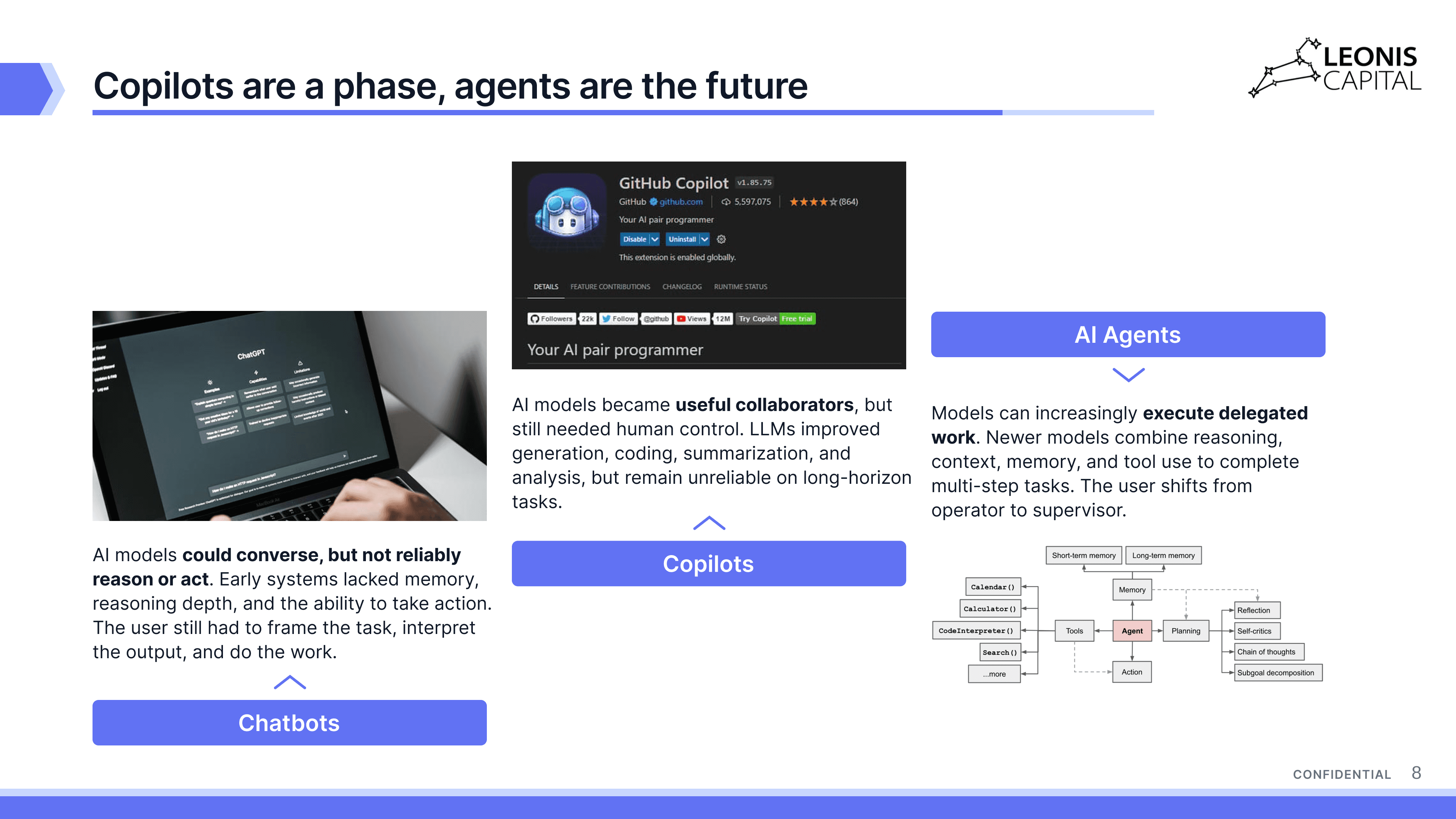
From an internal webinar for the Leonis community (Oct 2023).
The tools gaining the most traction, the writing assistants and productivity chatbots embedded into every enterprise suite, were all variants of the same pattern. They augmented the human but did not eliminate the work. We believed the enduring phase of AI would look different, where agents could receive a goal, act across multiple systems, and complete a task end-to-end without human supervision. At the time, we found no one building toward that future.
Then we met Fryderyk and Peter.
Building Before the Category Had a Name
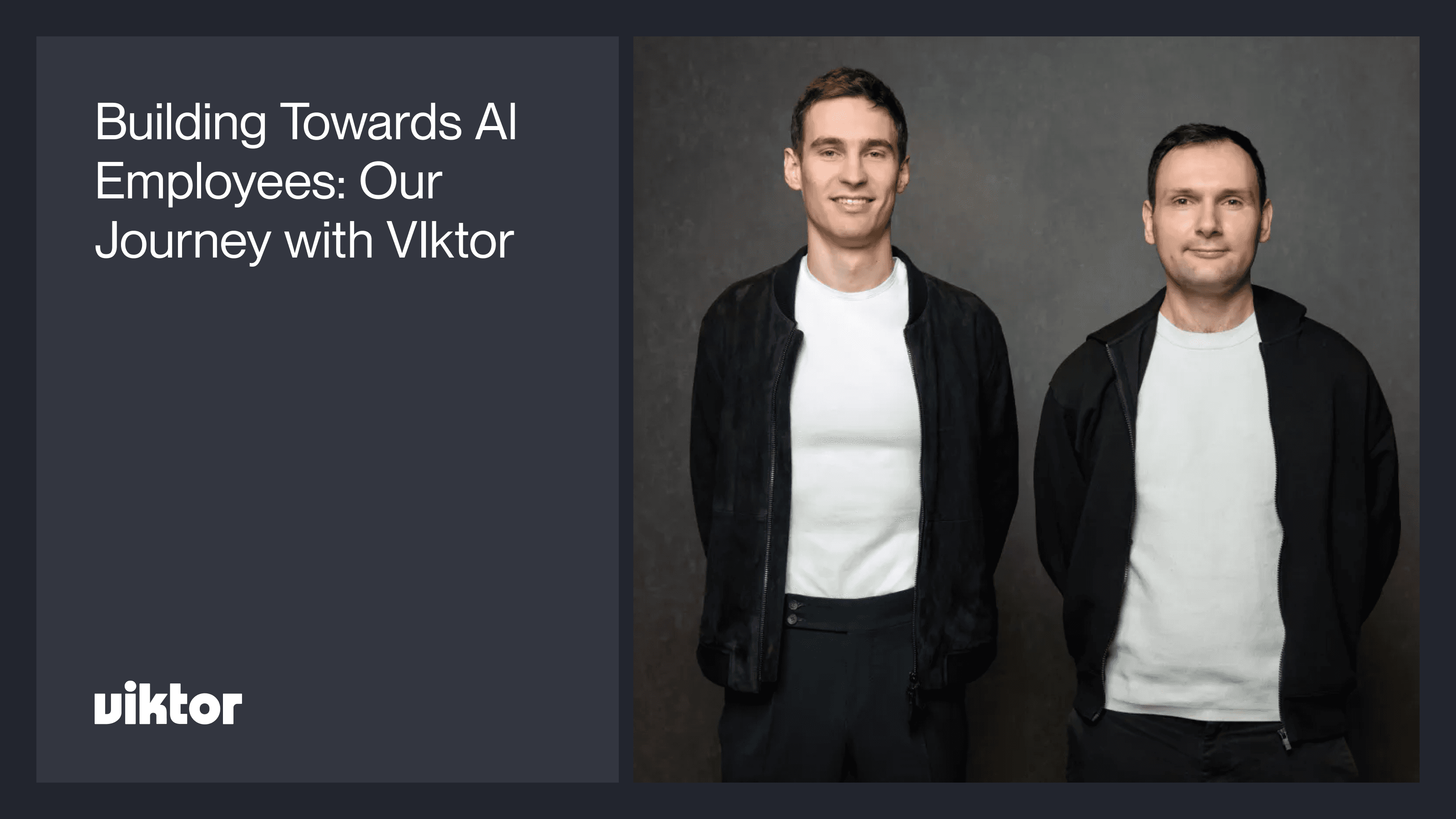
Fryderyk Wiatrowski and Peter Albert met at Meta while working in AI research. We found them by following the Llama 2 paper. When we learned that two Meta researchers were leaving to start a company, we reached out.
From the first conversation, the difference was clear. They were not asking, “How do we make people faster?” They were asking, “How do we help AI complete human tasks in one shot?” They wanted to build a true AI agent that can complete tasks end-to-end.
Back then, their vision looked premature to many. The agent category was still nascent, and most AI products were still framed around copilots and chat interfaces. But as research-driven investors ourselves, we saw the emerging underlying capabilities at the model layer. Instruction following, tool use, and context length were all advancing rapidly. The capabilities required for autonomous agents were not years away, they were set to arrive in the next 12 to 18 months. Fryderyk and Peter were already building for the other side of that threshold.
The Breakout Two Years in the Making
By the summer of 2024, the team was training AWA-1, their first autonomous action model. There was no product, no revenue, no conventional go-to-market at the time, we invested on technical conviction alone.

We signed the deal at a Joe and the Juice in downtown San Francisco, summer 2024.
What validated that conviction was what the founders discovered next. Through training their own models, they found that the real bottleneck in building a useful AI agent was not the model. It was persistent contextual understanding. A model that can act is useless unless it knows which information in a messy real-world interface actually matters.
That insight became their first product, Jace, an AI-powered email assistant built on top of their own model. Where other email tools generate generic replies, Jace learns how you write, understands the context of a thread, and drafts responses that sound like you wrote them. At Leonis, we were beta users from the day it first launched and still use it daily. It is the best email product we have ever used. From the outside, Jace looks like a simple product. That simplicity is the point. Getting an AI to reliably understand context, match tone, and act correctly across thousands of messy, unstructured conversations required deep engineering work that is invisible precisely because it works.
Viktor came next. It was originally launched as an experiment. The experiment took off. We added Viktor to our own team and saw the same thing we saw with Jace: it understood our context, our roles, our priorities. Not only that, Viktor took command and executed tasks, end-to-end, full stop. Tasks that would normally require a brief, a back-and-forth, and a review cycle were done correctly on the first try. It became indispensable within weeks. We were not surprised when it did the same for everyone else.
Viktor went live in February 2026 and hit a $15 million revenue run rate within ten weeks, operating inside over 2,000 businesses and organizations. In May 2026, the company raised $75 million Series A led by Accel.
To most observers, this looks like an overnight success. It is not. Viktor is the product of three years of work rooted in a thesis the founding team held before most of the industry had started asking the same questions: what does it actually take to build an AI employee that works?
The founders have been building in this category since before it had a name. They are just getting started.
If you are excited to help define the future of AI employees, Viktor is hiring. Explore open roles here.